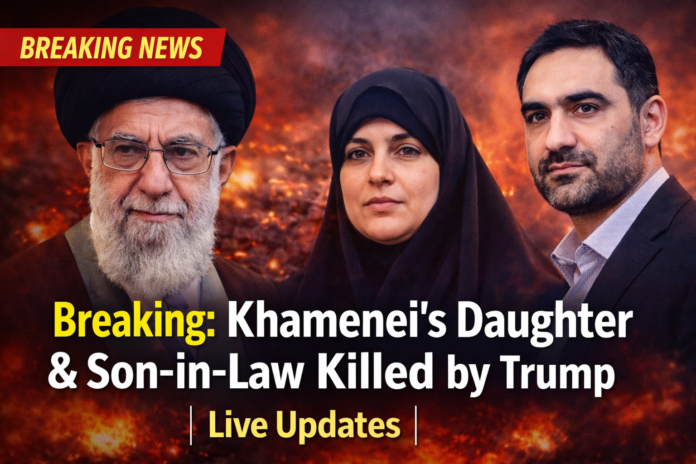
Khamenei’s Daughter and Son-in-Law Killed by US — this is the shocking news that has shaken the entire world. Iranian state media confirmed on March 1, 2026 that the daughter, son-in-law, granddaughter, and daughter-in-law of Iran’s Supreme Leader Ayatollah Ali Khamenei were all killed in a massive joint military operation carried out by the United States and Israel.
The strikes took place on Saturday, February 28, 2026, targeting Khamenei’s compound in the heart of Tehran. The attack, coordinated between US and Israeli forces, was one of the most dramatic military operations in recent Middle East history. It has sent shockwaves across the world and raised fears of a major regional war.
Iran has responded with fury. The Islamic Revolutionary Guard Corps (IRGC) announced it would carry out what it called ‘the most ferocious offensive operation in history’ against Israel and the United States. Iran has already launched multiple waves of retaliatory strikes targeting Israel and 27 US military bases across the Middle East.
This article brings you everything you need to know — who was killed, what happened, how the world is reacting, and what may happen next. We will keep updating this page with the latest confirmed information as events develop.
1. What Happened? The US-Israel Strike on Iran Explained
In the early hours of Saturday, February 28, 2026, the United States and Israel launched a massive coordinated military attack on Iran. The operation targeted multiple locations across Tehran, including the official residence and compound of Iran’s Supreme Leader Ali Khamenei.
According to two US sources and a US official familiar with the operation, Israel and the US deliberately timed the attack to coincide with a private meeting that Khamenei was holding with his top advisors and military aides. The goal was clear — to eliminate Iran’s top leadership in one powerful strike.
The Israeli Defense Forces (IDF) announced it had successfully completed a broad campaign targeting Iran’s strategic defense systems. Multiple waves of airstrikes hit Tehran and other major Iranian cities. Explosions were heard across the capital, and satellite images released later showed heavy black smoke rising from Khamenei’s compound.
[IMAGE: US-Israel joint military strike on Tehran Iran February 2026]
Explosions lit up the Tehran sky as US and Israeli forces launched coordinated strikes on February 28, 2026.
The operation also struck Iran’s missile systems, air defense infrastructure, and IRGC military bases. Senior Iranian officials had gathered at a secure location, and Israeli intelligence, working hand in hand with the CIA, tracked Khamenei’s movements to pinpoint his exact location.
US President Donald Trump confirmed America’s involvement in the operation, writing on Truth Social that Khamenei ‘was unable to avoid our intelligence and highly sophisticated tracking systems.’ Trump said the operation was carried out ‘working closely with Israel.’
This was the most direct military confrontation between the US and Iran in decades. While there have been proxy conflicts and previous airstrikes, this was the first time US forces directly participated in strikes that targeted Iran’s supreme leader personally.
Why Did the US and Israel Strike Iran?
The US and Israel justified the operation by pointing to decades of Iranian support for terrorism, its nuclear program, and its ongoing funding of groups like Hezbollah, Hamas, and the Houthis. Trump said the strike was ‘not only justice for the people of Iran’ but for Americans and people around the world who had been harmed by Khamenei’s policies.
Netanyahu framed the operation as an effort to remove the Ayatollah’s regime and give the Iranian people a chance to take back their country. He said: ‘For 47 years, the Ayatollah regime has called for Death to Israel and Death to America.’ Israel had long viewed Iran as its greatest existential threat, and the operation appeared to be the culmination of years of covert intelligence work and planning.
How Was Khamenei’s Location Found?
According to US officials, American intelligence tracked Khamenei’s movements on the day of the strike. Khamenei had secretly moved to a secure location and was meeting with his top advisors — including Ali Shamkhani and Supreme National Security Council Secretary Ali Larijani — when the strikes began. Despite all security precautions, the US-Israel tracking systems located him.
A senior Israeli official told Reuters that Khamenei’s body had been found following the strike, strongly suggesting he was killed in the attack. Trump also confirmed believing Khamenei was dead, writing on Truth Social: ‘Khamenei, one of the most evil people in History, is dead.’
2. Khamenei’s Daughter and Son-in-Law Killed by US: What We Know
Khamenei’s Daughter and Son-in-Law Killed by US is now confirmed by multiple Iranian state media outlets. On Sunday, March 1, 2026, Iran’s Fars News Agency and other major Iranian news outlets reported that the daughter, son-in-law, granddaughter, and daughter-in-law of Supreme Leader Khamenei were killed in the US and Israeli strikes.
The exact names of the daughter and son-in-law have not been officially confirmed by the Iranian government at the time of this writing. However, Fars News Agency quoted informed sources within the Supreme Leader’s household who confirmed the deaths.
The report from Iran’s state media stated: ‘After establishing contact with informed sources in the Supreme Leader’s household, the news of the martyrdom of the daughter, son-in-law, and granddaughter of the Revolutionary Leader has unfortunately been confirmed.’ The word ‘martyrdom’ is used in Iran to describe those who die in conflict.
Confirmed Family Members Killed in the Strike
According to multiple sources including Reuters, Times of Israel, and Iranian state media, the following family members of Khamenei were killed:
- Khamenei’s daughter — killed in the US-Israel airstrikes on Tehran
- Khamenei’s son-in-law — killed in the same strikes
- Khamenei’s granddaughter — also killed according to state media
- Khamenei’s daughter-in-law — killed as well, according to reports
A member of the Tehran City Council confirmed to Reuters that the son-in-law and daughter-in-law were killed in the strikes. This represents an extraordinary development — the direct killing of the family of a sitting head of state by foreign military forces.
Have the US or Israel Confirmed the Deaths of Khamenei’s Family?
As of the time of publishing, neither Washington nor Jerusalem had officially commented on the reported deaths of Khamenei’s family members. However, Israel did confirm that its strikes directly targeted the Supreme Leader and Iranian President Masoud Pezeshkian, according to Israel’s public broadcaster, quoting AFP.
The Iranian government has not issued a formal statement specifically about the family members, but state media has been reporting the deaths extensively, with national mourning declared across the country.
3. Who Was Khamenei’s Daughter and Son-in-Law?
Ayatollah Ali Khamenei has six children. He has been known to keep his family largely out of the public eye. His son Mojtaba Khamenei has been widely discussed in recent years as a possible successor to his father as Supreme Leader of Iran.
His daughters have lived much more private lives, rarely appearing in official government functions or public events. The son-in-law who was reportedly killed was connected to the inner circle of the Khamenei household and was believed to be present during the family gathering that coincided with the strikes.
It is deeply unusual for the family members of a world leader to be killed in a foreign military operation. The deaths of Khamenei’s daughter and son-in-law mark one of the most extraordinary and consequential events in modern Iranian history.
Khamenei’s Children: A Brief Overview
Khamenei was born in April 1939 in Mashhad, northeastern Iran. He rose to power after the Islamic Revolution of 1979 and became Supreme Leader in 1989 following the death of Ayatollah Khomeini. He ruled Iran with an iron grip for nearly four decades.
His son Mojtaba has long been seen as a powerful figure within the IRGC structure and has been groomed by many as a potential successor. However, Khamenei himself reportedly discouraged the idea of his own son taking over, wanting to avoid the appearance of a monarchy.
4. Was Khamenei Himself Killed?
This is the biggest question the world is asking right now. The situation remains partially unclear due to conflicting reports. Here is what we know:
Reports Saying Khamenei Was Killed
Iran’s state television announced a 40-day mourning period after the strikes, which is traditionally done in Iran upon the death of the Supreme Leader. State TV also declared seven public holidays. Iran’s IRGC issued a statement vowing to punish ‘the murderers of the Imam of the Ummah’ — a phrase used to refer to Khamenei as their spiritual and political leader.
US President Donald Trump stated on Truth Social that Khamenei was dead. Israeli Prime Minister Benjamin Netanyahu said there were ‘growing indications’ that Khamenei was killed. A senior Israeli official told Reuters that Khamenei’s body had been found and that documentation of the body was shown to Netanyahu himself.
Iran’s state television announced a 40-day national mourning period and called Khamenei a martyr, which is the strongest possible signal from Iranian media that he had been killed.
Reports of Uncertainty
Iran’s Foreign Minister Abbas Aragchi, speaking to NBC News, denied that Iran’s top leadership had been killed and said all leaders were alive. A post also appeared on Khamenei’s official X (formerly Twitter) account after the strikes, suggesting he might have survived.
However, analysts note that these denials may be strategic — designed to maintain order and avoid panic inside Iran while the government assesses the situation. The fact that state TV declared 40 days of mourning remains the most powerful public indicator that Khamenei is dead.
[IMAGE: Ali Khamenei Iran Supreme Leader 2026]
Ayatollah Ali Khamenei, Iran’s Supreme Leader since 1989, was reportedly killed in the US-Israel joint strike on February 28, 2026.
What Happened to Khamenei Before the Strike?
Iranian officials had promised to release a recording from Khamenei shortly after the strikes, but no such recording has been made public. Two Iranian sources told Reuters that Khamenei was meeting with top advisors Ali Shamkhani and Ali Larijani at a secure location when the strikes hit. The preliminary Israeli assessment was that Khamenei was hurt in the strike, with later intelligence indicating he was killed.
Khamenei, who was 86 years old, survived a serious bomb attack in 1981 that permanently paralyzed his right arm. This time, however, the intelligence and precision of the US-Israel operation appears to have been far beyond anything Iran could defend against.
5. Iran’s Reaction: IRGC Vows Revenge
The Islamic Revolutionary Guard Corps, Iran’s most powerful military force, did not hold back in its response. Within hours of the strikes, the IRGC released a statement saying: ‘The hand of revenge of the Iranian nation for a severe, decisive and regrettable punishment for the murderers of the Imam of the Ummah will not let go of them.’
The IRGC also announced it would launch what it called ‘the most ferocious offensive operation in history’ against both Israel and the United States. This is not just rhetoric — Iran has already launched massive waves of missile and drone attacks on Israel and 27 US military bases across the Middle East.
Iran’s Military Response So Far
Following the strikes, Iran fired successive barrages of missiles and drones targeting Israel and American military positions across the region. The attacks hit multiple US bases in countries across the Middle East, though the full extent of casualties from these Iranian strikes has not yet been confirmed.
Iran’s Security Council also instructed residents of Tehran and other major Iranian cities to stay in safe, protected locations until further notice. The country appears to be preparing for a sustained conflict with the US and Israel.
Iran’s Foreign Minister Speaks Out
Iran’s Foreign Minister Abbas Aragchi told NBC News that Iran’s retaliatory strikes were intentionally limited to US bases and that Iran wanted to de-escalate the situation. He said the US could reach out to end the crisis. However, he made clear: ‘This is a war of choice by the United States, and they have to pay for that.’
Despite these statements, Iran’s military actions suggest a country gearing up for a prolonged confrontation. The IRGC has declared war on the US and Israel, and the coming days will determine how far this conflict escalates.
6. US President Trump’s Statement
US President Donald Trump did not hold back his feelings about the strike. On his Truth Social platform, Trump wrote that Khamenei was ‘one of the most evil people in History’ and declared him dead. He said the killing was ‘not only justice for the people of Iran, but for all Great Americans, and those people from many Countries throughout the World, that have been killed or mutilated by Khamenei and his gang of bloodthirsty thugs.’
Trump also called on Iran’s security forces, including the IRGC and military, to lay down their arms. He said: ‘This is the single greatest chance for the Iranian people to take back their country.’ Trump also offered free nuclear fuel to Iran in exchange for ending its nuclear enrichment program, but Iran reportedly rejected this offer.
Trump’s Call for Regime Change
Following the strikes, Trump openly called for regime change in Iran. He urged the Iranian people to rise up and remove what he called the ‘yoke of tyranny.’ He said that many IRGC soldiers and security forces were looking for immunity and no longer wanted to fight.
Trump also stated that US strikes on Iran would continue until peace was secured, making it clear that this was not a one-time operation but part of a broader strategy to reshape the Middle East political landscape. He hailed the death of Khamenei as a moment of justice and historical reckoning.
7. Israel’s Role: Netanyahu Speaks
Israeli Prime Minister Benjamin Netanyahu announced the strike in a televised address on Saturday evening, describing it as a carefully planned operation to remove the Ayatollah’s regime from power. He thanked US President Trump for his ‘historic friendship’ and said the two countries had worked closely together to make the operation possible.
Netanyahu stated: ‘This morning, in a powerful surprise attack, we destroyed the compound of the tyrant Khamenei.’ He said the attack ‘will create the conditions for the brave Iranian people to take their destiny into their own hands.’ He urged all sections of Iranian society to ‘remove the yoke of tyranny’ and build ‘a free and peace-loving Iran.’
IDF Confirms Senior Iranian Officials Killed
IDF spokesperson Effie Defrin confirmed that two separate strikes were carried out in Tehran, and that several senior Iranian officials were killed. The IDF confirmed that the following high-ranking Iranian figures were killed in the strikes:
- Mohammad Pakpour — IRGC Commander
- Amir Nasirzadeh — Iran’s Defense Minister
- Ali Shamkhani — Advisor to Khamenei and former National Security Council Secretary
- Mohammad Bagheri — Chief of Staff of the Iranian Armed Forces
The scale of losses among Iran’s senior military and political leadership is staggering. In a single night, Iran lost many of its most powerful decision-makers.
Israel’s Intelligence Operation
The operation relied heavily on Israeli intelligence gathering, which had apparently tracked Khamenei’s movements and the location of his key meetings for some time. Israel’s Mossad is widely regarded as one of the world’s most capable intelligence agencies and has a long history of operations inside Iran.
The successful targeting of Khamenei’s private compound — while he was in a meeting with his top aides — suggests that Israeli and American intelligence had penetrated deep into the most secure circles of the Iranian government.
8. Other Senior Iranian Officials Killed in the Strike
In addition to the deaths of Khamenei’s family members and the Supreme Leader himself, the US-Israel strikes killed a large number of Iran’s most senior officials. This effectively decapitated Iran’s military and security leadership in one night.
IRGC Intelligence Commanders Killed
Iran International reported that four senior Iranian intelligence commanders were killed in the strikes:
- Javad Pourhossein — Head of the Foreign Intelligence Unit
- Mohammad-Reza Bajestani — Head of the Security Unit
Additionally, Reuters reported that at least three members of Iran’s IRGC-linked Basij paramilitary forces were killed in the strikes. The Basij is an internal security and militia force that has been used throughout the years to suppress domestic protests in Iran.
Iran’s Air Defense Also Hit
The IDF confirmed that one strike was specifically directed at an advanced SA-65 aerial defense system located in the Kermanshah area in western Iran. The successful destruction of Iran’s air defense systems means Iran is now far more vulnerable to future strikes. The IDF also conducted multiple overnight sets of strikes on Iran’s missile launchers to reduce the threat of further Iranian attacks on Israel.
9. Iran’s Retaliatory Attacks: What Happened Next
Iran did not wait long to respond. Following the US-Israel strikes, the Islamic Republic launched an unprecedented wave of retaliatory attacks. Iran fired successive barrages of missiles and drones targeting both Israel and US military bases across the Middle East.
Reports indicate that Iran specifically targeted 27 US military installations in the region. While the full scale of the damage from these Iranian strikes is still being assessed, they represent the largest direct Iranian military attack on US positions in history.
Iran’s Attacks on Israel
Iran also launched waves of missiles and rockets targeting Israeli cities and military installations. Israel’s Iron Dome and other missile defense systems intercepted many of the incoming projectiles, but the sheer volume of the attacks put immense pressure on Israel’s defenses.
Following months of relative quiet on the Israeli home front, sirens began wailing again across the country. Israelis spent Shabbat running in and out of bomb shelters. Schools and most businesses in Israel were ordered to stay shut on Sunday as the conflict intensified.
Iran Strikes Gulf States Too
Reports also indicated that Iran’s retaliation extended to Gulf states in the region, though details remain unclear. Iran fired at what it called 27 US bases across the Middle East, which means several countries hosting American military personnel may have been impacted by the strikes.
10. 40 Days of Mourning Declared in Iran
In a powerful sign that Khamenei is indeed dead, Iran’s state television announced a 40-day period of national mourning following the strikes. Seven public holidays were also declared across the country. In Shia Islam, 40 days of mourning is a deeply significant tradition, typically reserved for the deaths of revered religious and political leaders.
Footage aired by Iranian state television showed black-clad mourners gathering outside government buildings in Tehran and other cities. Senior clerics delivered televised addresses urging national unity in the face of what they described as foreign aggression.
[IMAGE: Iranians mourning Khamenei death Tehran 2026]
Iranians gather outside government buildings in Tehran to mourn the death of Supreme Leader Khamenei, March 1, 2026.
The announcement of 40 days of mourning is the single most significant indicator that Khamenei has died. This is not a declaration the Iranian government would make for a living leader. It is a deeply solemn tradition that marks the end of the leader’s life and the beginning of a period of national grief and transition.
11. Iranian Diaspora Reacts: Mixed Emotions
Outside of Iran, the Iranian diaspora — millions of Iranians living in exile around the world — reacted with a complex mix of emotions. Many celebrated the potential fall of the Islamic Republic and Khamenei’s reported death, seeing it as the beginning of a new era for Iran. Others expressed concern about the violence, civilian casualties, and the risk of a wider war.
In major cities with large Iranian populations — including Los Angeles, Toronto, London, and Dubai — Iranians gathered in public spaces to watch the news and discuss what the events meant for their homeland.
Reza Pahlavi Celebrates
Exiled Crown Prince Reza Pahlavi, son of the last Shah of Iran, publicly celebrated Khamenei’s reported death. He called Khamenei a ‘bloodthirsty tyrant’ and said he had been ‘erased from the page of history.’ Pahlavi has long advocated for regime change in Iran and has been a leading voice in the Iranian exile community.
Others Fear the Consequences
Not all Iranians in exile were celebrating. Many expressed deep concern about what comes next. With Iran’s top leadership wiped out and the country in crisis, the risk of chaos, civil war, or a power struggle inside Iran is very real. The IRGC remains a powerful force and may attempt to hold onto power even without Khamenei at the helm.
12. What Is the IRGC and Why Does It Matter?
The Islamic Revolutionary Guard Corps, known as the IRGC, is Iran’s most powerful military organization. It is separate from Iran’s regular army and answers directly to the Supreme Leader. The IRGC controls vast swaths of Iran’s economy, manages its nuclear program, and runs its network of proxy forces across the Middle East.
Khamenei placed the IRGC at the center of power during his decades-long rule. It is the backbone of the Islamic Republic’s military might. Even with Khamenei dead and its top leadership decimated by the strikes, the IRGC remains a formidable force with thousands of soldiers and sophisticated weapons.
IRGC’s Network of Proxy Forces
The IRGC controls a network of proxy militias across the Middle East that have been funded and armed by Iran for decades. These include Hezbollah in Lebanon, Hamas and Islamic Jihad in Gaza and the West Bank, the Houthis in Yemen, and various Shia militias in Iraq and Syria. Even if Iran’s central government collapses, these proxy forces have their own chains of command and weapons stockpiles.
The IRGC’s power means that even after the death of Khamenei and the destruction of much of Iran’s senior leadership, the Islamic Republic is not going to collapse overnight. The coming weeks and months will determine whether the IRGC chooses to fight on, negotiate, or fracture internally.
13. Who Will Replace Khamenei as Supreme Leader?
This is one of the most important questions now facing Iran and the world. Khamenei has been in power since 1989. He was Iran’s second and longest-serving Supreme Leader. His death creates a massive power vacuum at the very top of the Islamic Republic.
Iran’s constitution calls for an Assembly of Experts — a body of senior clerics — to select a new Supreme Leader. However, with so many top officials dead and Iran under attack, the normal constitutional process may be impossible to follow.
Mojtaba Khamenei as Possible Successor
In recent years, Khamenei’s son Mojtaba had been widely discussed as a possible successor. He has built strong relationships within the IRGC and has been seen as his father’s political heir. However, many within the clerical establishment opposed the idea of a son succeeding his father, viewing it as too similar to a monarchy and against the principles of the Islamic Republic.
The Role of the Assembly of Experts
Normally, the Assembly of Experts would convene and choose a new Supreme Leader from among Iran’s senior clerics. However, the chaotic circumstances of Khamenei’s death and the ongoing military conflict make this process extremely difficult. Iran is in a state of war, its senior leadership is decimated, and the country faces enormous internal and external pressure.
The coming weeks will be critical in determining whether a new Supreme Leader can be selected quickly and whether the Islamic Republic as a system can survive the loss of Khamenei and so many of its senior figures.
14. The History of US-Iran Tensions
To understand why this happened, it helps to look at the long history of conflict between the United States and Iran. Relations between the two countries have been hostile since the 1979 Islamic Revolution, when Iranian students stormed the US embassy in Tehran and held 52 American diplomats hostage for 444 days.
Since then, the US and Iran have been in a state of continuous confrontation — through proxy wars, economic sanctions, cyberattacks, and occasional direct military skirmishes. The US designated the IRGC as a terrorist organization. Iran repeatedly called for ‘Death to America’ and ‘Death to Israel’ in its official rhetoric.
Key Moments in US-Iran Conflict History
Some of the most dramatic moments in the US-Iran conflict include the 1988 US strike on Iranian oil platforms during the Tanker War, the 2020 US killing of IRGC General Qassem Soleimani in Iraq, Iran’s subsequent missile attack on US bases in Iraq, and numerous rounds of nuclear negotiations that collapsed without agreement.
The killing of Soleimani in 2020 was previously considered the most dramatic direct confrontation between the US and Iran. But the 2026 strikes — targeting Iran’s Supreme Leader himself on Iranian soil — represent a completely different level of escalation.
Iran’s Nuclear Program
At the center of US-Iran tensions for the past two decades has been Iran’s nuclear program. The US and its allies have long feared that Iran was secretly trying to develop nuclear weapons. Iran has always denied this, claiming its nuclear program is purely for civilian energy purposes. Multiple rounds of international negotiations — including the 2015 JCPOA nuclear deal — failed to permanently resolve the issue. Senior US officials have claimed that Iran demanded the right to preserve its nuclear enrichment ability, which the US interpreted as an attempt to maintain the option of building a nuclear bomb.
Read more: History of US-Iran relations (Council on Foreign Relations)
15. The History of Israel-Iran Conflict
Israel and Iran were not always enemies. Before the 1979 Islamic Revolution, Iran under the Shah was actually one of Israel’s key strategic partners in the Middle East. That relationship changed completely when Khomeini came to power and declared Israel an illegitimate state.
Since 1979, Iran has been Israel’s most vocal enemy, funding groups that attack Israel and repeatedly threatening to destroy the Jewish state. Israel, in turn, has conducted numerous covert operations inside Iran — including the assassination of Iranian nuclear scientists and cyberattacks on Iran’s nuclear facilities.
The Shadow War Between Israel and Iran
For years before the 2026 strikes, Israel and Iran were engaged in what experts called a ‘shadow war’ — a series of covert operations, proxy battles, and intelligence conflicts that stopped short of direct military confrontation. Israel struck Iranian positions in Syria, Iran funded Hezbollah attacks on Israel, and both sides engaged in sophisticated cyber and intelligence operations against each other.
The 2026 strikes represent the end of the shadow war and the beginning of a direct, open conflict between Israel and Iran — a development that has profound implications for the entire Middle East.
Read more: Israel-Iran conflict explained (BBC News)
16. International Community Responds
The international community has reacted with a mix of alarm, condemnation, and cautious support. The scale of the US-Israel operation and the reported deaths of Khamenei and his family have shocked world leaders.
United Nations Calls Emergency Session
The International Atomic Energy Agency (IAEA) has called for an urgent session following the US-Israel attacks on Iran. The killing of the head of state of a major nation and the targeting of nuclear-related facilities raises enormous questions about international law, nuclear safety, and global security.
Russia and China React
Russia and China, both of which have had close relationships with Iran, are expected to strongly condemn the strikes. Both countries have significant economic and strategic interests in Iran and have previously opposed US and Israeli military actions in the Middle East.
Gulf States React Cautiously
The Gulf Arab states — including Saudi Arabia, UAE, and Qatar — have historically been threatened by Iran’s regional ambitions. While many quietly welcomed the weakening of Iran, they are also deeply concerned about the regional instability that could follow.
17. Could This Lead to a Wider War?
This is the question on everyone’s mind. The killing of a sitting Supreme Leader and his family by a foreign military power is an unprecedented event in modern history. Iran’s IRGC has vowed the most ferocious military response in its history. Iran has already launched attacks on 27 US military bases and fired barrages at Israel.
The risk of a wider regional war is very real. If Iran continues escalating and draws in its proxy forces — Hezbollah, Houthi, and Iraqi Shia militias — the conflict could engulf the entire Middle East and potentially drag in Russia, China, and other major powers.
What Could Stop a Wider War?
Several factors could prevent the conflict from spiraling into a full-scale regional war. Iran’s Foreign Minister has signaled a willingness to de-escalate if the US reaches out. The US has deployed additional military assets to the region to deter further Iranian attacks. And within Iran, there may be voices pushing for pragmatism over revenge, particularly if the country’s leadership is in chaos.
However, the IRGC’s vow of the ‘most ferocious offensive operation in history’ suggests that Iran’s military establishment is not ready to back down. The coming 72 hours will be critical in determining whether this conflict stays limited or explodes into something much larger.
Live updates: Follow the latest from Al Jazeera
Live updates: CNN live coverage of Iran-Israel conflict
18. Live Updates Timeline
Saturday, February 28, 2026
- Early morning: US and Israel launch coordinated strikes on Tehran and multiple Iranian cities.
- IDF confirms strikes on Iran’s air defense systems and IRGC targets.
- Khamenei’s compound in central Tehran takes direct hits. Black smoke visible in satellite images.
- Trump posts on Truth Social confirming US involvement and claiming Khamenei is dead.
- Netanyahu delivers televised address confirming Israel struck Khamenei’s compound.
- IDF confirms IRGC commander, Defense Minister, top military officials killed.
- Iran begins retaliatory strikes on Israel and 27 US military bases across the Middle East.
Sunday, March 1, 2026
- Iranian state media announces 40 days of national mourning.
- Fars News Agency and Iranian state media confirm Khamenei’s daughter, son-in-law, granddaughter, and daughter-in-law killed.
- Tehran City Council member confirms son-in-law and daughter-in-law killed in strikes.
- Iranian Foreign Minister Abbas Aragchi speaks to NBC News, says Iran wants de-escalation but US must pay.
- Iran continues retaliatory strikes. IRGC vows most ferocious offensive operation in history.
- Israeli schools and businesses shut. Sirens across Israel. Citizens shelter in bomb shelters.
- IAEA calls emergency session over Iran nuclear safety concerns.
- Trump says US strikes on Iran to persist until peace secured.